dissabte, 16 d’abril del 2016

An example of world's injustices

Not many days ago, we went to MACBA (Barcelona Museum of Contemporary Art) with school and something a little weird happen to us. The whole art history class were in the museum with a fantastic guide when suddenly, out of the blue, a man join us and start to follow us in our visit for the museum. Anybody said nothing and in fact, I didn’t notice that he was in our group until he started to speak. I have to say that he was a little bit strange man and also, it was a strange situation! It seems that he was an expert of philosophy because he talked about different philosophers, theories and he said something that really grab my attention: “we are in an era full of images that we didn’t understand, we don’t understand our own world, it’s like we were backing instead of going on”.
Why I’m explaining this? Is not for start a philosophic debate about this statement but I would like to talk about a thing that grabs even more my attention and thta was related to this sentence. If you have traveled abroad, you will know what it’s read ads or posters in the street and feel a little strange because you don't understand anything! But imagine something worst, imagine that you don't even know read. Then, you understand less of what are around you. This, in 21st century, can seem something very strange that only happened in specific places, in specific situation and in specific people but in fact, this is a pitiful reality that is happening nowadays and not only in the “third-world”, as many of us will think, it’s something that touches us very closer because is happening  in our country.
Some days ago, I was taking an English lesson outside high school and suddenly, a group of old African immigrants (the youngest one was 50 years old) enters in the place and we asked our teacher if they were also taking English classrooms. Our English teacher explain to us that they were trying to learn write and speak our language what impress me a lot! Many of them have been living there about two or three years and they have been walking around without understanding which enveloped them and what is worst, is that except one of the five, anybody even know how to write their  own language; they were starting from scratch.
I found amazing, impressive and astonishing that I was sitting in a classroom studying English, my third language, and just at the other side, only separated by a door, a group of people was trying to learn how to write for the first time… it’s something that you can get easily. How can be that something as important as education that in our country reaches to bore most of the pupils, in other places is something that not all child have access? It’s a great injustice because educations is considered a basic right.
For this, I would like to say that I found praiseworthy what these people are doing, they are not only an example of overcoming because we have to take into account that at these ages, it’s very difficult to learn a new language and even more, start learning from the beginning: when you are a child all is simple, you are growing up and you are more receptive. Our English teacher talk about the difficulties that she have to teach and also the difficulties that they have to learn, it’s a very slow process. With this example, we can also reconsider the lucky we are for have born in a place where we can have not an easy but a compulsory access to a basic education. These people are a perfect example of the big injustices that exist in the broad 21st century and that it is in our hand change it, look them: it’s never too late for an education.

diumenge, 10 d’abril del 2016

Greece faces the challenge of handling thousands of requests for asylum

Exhausted by the economic crisis, now Greece has to face a huge migration crisis. This July, when Greece moves away from an “economic crack”, every day thousands of migrants arrived at the Greek islands, a flow that keeps growing. In only December, arrived more than 200.000 persons but then, Greece were just a scale, the Greek authorities only have to attend the emigrants a few days and then, let them continue their journey to the north, to Germany especially. But now this is impossible, the borders are closed and Greek is overflow.
Since January, the Greek authorities have received more than 10.000 asylum applications what suppose a problem for the government: the process of revising this request can take years, each case must be attended individually, in a confidential way, interviewed by asylum experts, with interpreter and a lawyer and for this, the government has decided to approve a new law with the objective of examining in an expressway (by 15 days) the asylum applications.  Meanwhile, more than 2.800 refugees are living in makeshift refugee camps in hockey and football stadiums.


I find this new interesting because we can see very clear that although each government of each European country is very conscious about human rights and the importance of respect them, into practice, all is very different. This is not one of the worst new you can find about what refugees are living. Day after day, hundreds of people try to arrive at our countries risking their lives and also, the life of their families and leaving everything behind. 
This last weekend I was watching a football match on TV and I see a poster that gets my attention: “Not to racism”. Immediately comes to my head the image of thousands of refugees who day by day try to cross our borders and reach Europe while we close the door. Is not this a form of discrimination? I know and I understand that a country can’t welcome thousands of refugees day in day out, but governments should be more conscious about the situation of these people and must take decisions: it can’t be that millions of men, women, child,… have to be living in precarious conditions in our borders because the governments are still “taking decisions”, many of the refugees that arrive at our countries have already faced many problems (the war, what supposed to leave your country, the immigration journey,…) for finding our doors close. For this I think that what Europe is doing with refugees it can’t be considered racism, the racism is de discrimination toward a person and Europe is dehumanizing refugees.

dissabte, 9 d’abril del 2016

Let's talk about Human Rights

I’m pretty sore that all of us have heard about the human rights and the importance to respect all of them because unfortunately, nowadays, this is one of the most current topics in all political and social discourses, both authorities and civil society organizations and public opinion and I think that it’s a shame selling the idea of human rights in that way because, how many of us comprise the true meaning and the importance of human rights? Or does anybody know how many human rights are? Or when and why were they created? Celebrating human rights once a year is important, but living human rights every day is essential.
So let’s start for the beginning. What are human rights? Human rights are rights inherent to all human, whatever our nationality, place of residence, sex, national or ethnic origin, colour, religion, language, or any other status. We are all equally entitled to our human rights without discrimination.
Now, we can tackle the second question: when and why were they created? The idea that all human should enjoy some basic and common rights could be found in some of the oldest civilizations but it will not be until the 17th century that we would find the modern concept of Human Rights and it’s also in that moment when the firsts great statements of human rights were written in the English colonies of North America, driven by their conflict with the English crown and followed by the United States Declaration of Independence: “All men are created equal and all men are endowed by their Creator with certain inalienable rights, among which there are the right to live, liberty and the pursuit of happiness ... "  - Thomas Jefferson. And a decade later, in a Europe shook by the French Revolution, the Declaration of the Rights of Man and of the Citizen were proclaimed.
During the 18th century, Montesquieu and Rosseau ideas were fundamental and, in fact, we can say that that century and the next one, were an important ones for what human rights respects for the slow consolidation of the ideals proclaimed in the French Revolution but then, the 20th century comes accompanied by two world wars, countless regional wars, civil wars, bloody revolutions,… but we learn from our mistakes, or the say, and the WWI were followed by the creation of the Society of Nation, that although it was unable to prevent WWII, it had the merit of being the precedent of the creation of the United Nations, that followed the WWII.
Finally, in 1948, the Universal Declaration of Human Rights was approved with a list of thirty rights.
Now that we know a little more about human rights, I would like to deepen in one right in particular: the freedom from slavery, that said the next.
Article 4th, freedom from slavery:  “No one shall be held in slavery or servitude; slavery and the slave trade shall be prohibited in all their forms”.
Slavery is an event that has been going on for many years. This practice has appeared almost universally throughout history among peoples of every level of material culture; from Ancient Rome to the United States in the 19th century, however, in no other culture had slavery been exclusively associated with one race, so we can define slavery as ‘the involuntary servitude of one person to another or one group to another’. We have to be aware that the slavery has existed in each continent since ancient times, in all cultures, religions and historical periods.


In ancient, the slavery was completely assimilated and it was no questioned. In fact, Aristotle, like most thinkers of antiquity, defended his need. The slaves were considered "Chattels", "stuff" or "objects" so they could be bought and sold as commodities, they didn’t have any right and in the best of the cases, if they were treated minimally well, it wasn’t for the fact of being a human but for the necessity of the owners of having a worker in good conditions. In  women, the cases were a little different because their slavery was related to their sexual exploitation.
In the 20th century the traditional slavery was practically wipe out, but out of the blue in different places and moments, appears a new brutal way of slavery blind together to the German and Japanese expansionism and the dictatorship revolutions and giving place to Japanese reclusion camps, to Nazi and soviets concentrations camps,…
The abolition of slavery in Europe and America was the result of the tireless activity of some individuals and groups, but the truth is that with the freedom, it doesn’t come a life of quality and equality but the slavers continued suffering from their “condition”: they weren’t treated in the same way that the people who used to own slaves and, in fact and unfortunately, this “mentality”, somehow or other, continues present in our societies.
Despite the enactment in 1926 of the Slavery Convention and the Universal Declaration of Human Rights of 1948 in the 21th century,  still exist various forms of slavery: the traditional ones related to the slave trade, sexual exploitation,… and other ways of slavery related to forced labour, child labour,…
In fact, after thousands of years after this injusty appearance we can’t yet say that we have ended with the slavery in the world because, moreover, new ways of slavery continue to appear. We can say that it’s a crime difficult to identify and above, it provides great benefices to those who take advantage of this businesses: it’s in all countries around the world and it’s a sad reality of the 21th century.
This business makes children women and men, often motivated by their dreams and expectations of having a better live, be subjected to exploitations of all kind and directed by companies or individuals.
If we look at the datum, we can see that the numbers are frightening: 4, 5 millions of women and little girls are sexually exploited while more than a milion of people  are forced to work in activities related to the manufacturing and domestic jobs and in very poor conditions: working more than fifteen hours a day, in filthy places, without breaks, without any guarantee or security and with a very, very, very poor salary.
So as we can see, not all Human Right are respected for everyone and everywhere and this is something about we have to work because there is nothing more important for having a great life than the fulfilment of these.

diumenge, 3 d’abril del 2016

"Why I hate school but love education" -Suli Breaks

I'm coming across with an inpsiring video: somehow Suli Breaks has bagged millions of hits with his breakthrough monologue "Why I hate school but I love education". In only six minutes this british student makes you doubt if education has the value thta you've always have given to it and even, if the educational system thta we have is the best one. So I recomend you to take a minute to watch the whole video because it woth it. 
“Education is about inspiring one's mind not just filling their head”, said Suli Breaks. If you search “School is” in Google, you will get: “School is a waste of time”, “School is boring”, “School is prison”… If you search “School makes me feel”, you will find: “School makes me feel suicidal”, “School makes me feel worthless”… And that’s because the educational system is not working properly; if you fail a test, it makes you feel like a failure and this is not a way to inspire or teach people. Now Google “Education is”, and you will get “education is the key to success”, “educations is freedom”, “educations is the great equalizer" “Education inspires, with an education you can chase your dreams, with an education you can do whatever you want…” In fact, there also are sentences that we are used to but I have to say that not once in school I have learned how to “chase my dreams”, how to explore what I want to do after college,… but of course, I have learned where Uganda is and the complexities of polynomial systems.
I believe that one of the main problems of school is that we should not solely be learning about other people’s theories, ideas or perspectives on a subject and then, throw up it in an exam and forget what you have “learned” forever and pass to the next theory, idea or perspective because, how many of us has study something so hard for then, forgive it after the exam? For this, I thik that education should be find and learn about our own perspectives and ideas and what that means.  School should be about inspiring people to strive for the best in anything that they do instead of showing students at what 
they are good or bad according to a mark, education should  be about showing students new skills and opportunities and not crossing they answers because they are “out of the checklist”; education shouldn’t be closing students in a grey room and teaching them about hyperboles and Pythagoras theorems and convincing them that knowing this techniques will bring them a better life or that a university degree will solve all your problems because, in fact, that’s the way our society runs: you are told day in day out about going to primary school, going to secondary school, get a degree, work, have a family and put your child in the same cycle. But, "let me ask you this; what are you studying for?" People say that education is the key to success and I’m sure you have heard your parents, your teachers and most people in society saying that you need to through high school, get into the best college you can and then, get a job. And there’s so much pressure to follow this path. The whole process is about being six hours in a classroom, trying to get a grade, trying to pass the next text and trying to finish the latest assignment. School is about memorizing dates, times and numbers for what? You will never think again about the year that Cervantes loose his hand or where Tirkemeinstan is; I’m still waiting the moment in my life when I can use all my knowledge about subordinate sentence.
With this, I’m not saying that school is wrong and it’s better not to go, I’m saying that the way that it works, the way that it “educates”, it’s not the best one. Education is about experiences, building yourself and learning. I think that the first priority of all education system should be hep students to find their potential and not make sure you can finish a book before the year ends and schools, at the moment, are not providing this. We are just told how great other people have been and what’s the next step we should take for have a “good life”; we never learn what we can really do or about what ideas we have and what does it mean.
Finally, If you search the definition of “education” in a dictionary you will find the next: “the act or process of educating; to teach (a person) by instruction or school” and in fact, this is exactly what our education system is doing nowadays, you go to school for “filling your mind”, for instructing yourself, instead of “inspire” your mind. For this, I would like to end providing a new definition of what I think that education should be: “Education is the process of inspiring, engaging and encouraging people to construct their own view, to build their own ideas and their own thought processes”.

diumenge, 13 de març del 2016

Children tales

A few days ago, I read an article written by Santiago Rocalingo that talked about what he thinks about the children's STORIES or the fairy tales. The author believes that the children's STORIES shouldn't be for educated the children or for give them certain "good" values, it should serve to entertain them. For this, the author is against the modification of children's books like Hansel and Gretel, The Little Thumb and many more which the original plot talked about leave the sons in the middle of the forest, children who steals,... and rewrite them trying to turn them in "politically correct stories" as the author says, where the bad character always lose (but without violence) and the good one always succeeds, the families are always nice and the characters an example. The author think that in this way, we are not protecting our CHILDREN, we are creating drag stories and making that children prefer the TV or the PlayStation where they can PARTICIPATE in wars and kill as many people as the want without anybody says nothing. I DON'T not totally agree with the author. In one hand, it's true that children's stories could be a little BORING because are always the same: there’s a good character with who the child want to identify because should be the hero of the story, should have a lot of friends and should win against the bad character. This bad characters is the one who the child don't want to identify because should be ugly, rude, without friends (in some cases he have a henchman who isn't as bad as his master but who will follow him anywhere he goes or will do anything he say) and should lost against the good character. This is in that way because children's stories are directed to a public who is still learning to differentiate between what it's right and what it's wrong and for this, they need to set in a good model who have the right attitude and with who can be identify. If it weren’t in that way, which role model we would be teaching to the children? But on the other hand, I think that it's also true that nowadays, it's useless try to change the children's books because they can play with the more violent play in the PlayStation, the computers,...


"A castle for my princess"

Like almost every girl in the world, Emily Heaton wanted to be a princess. This don't have anyhing of strange or excepcional and neither her model: it wasn't the Spain queen otherwise a Dinsey princess.
Jeremiah Heaton, the father, is the owner of a security company in the coal mines in the region of Abingdon, at the south of the Virginia State. Two years ago, he was asked by his daughter if some day she would be a real princess. He thought that she was acting like every girl in her age (she was 6 years old) and he answered of course she WOULD. The problem was that Emily was talking seriously and she said thait "it was soemthing importnat for she". So that, Heaton STARTED to search around the world a place without owner where his doughter could be the princess, and the last month he finally has found it: he planted a flag (made by the three soon of Jeremiah) in Bir Tawil, a piece of te Sahara desert of 2.060 square kilometers and between Egypt and Sudan and until now, unclaimed by any of the neighboring countries. So since the last 16th of April, Emily is a princess, but this is not all: recently, Disney had announced that after almost a year of talks with the Heatons family, they have decided to make a film with this story: the adventure of the father for try to give to his doughter a place where she could be the princess. Emily can't ask for more!
But, like in every Disney movie, there is always the bad character althought in this case, here are two bad characters: the reality and politics. It's true that Bir Tawil is a "empty place" I mean, anybody has claimed it untill now, but you need the approval of the International Comunity (starting with Sudan and Egypt) for impose a sovereignty. Further, you need to pas by Sudan or Egypt for arrive to this area and in one side, Sudan appears in the list of "The states sponsors of terrorism" and the United States don't allow you to travel to this country. In the other side, the departament of Egypt took motnhs fo give a permission to Jeremiah for travel to this area and besides, it tooks three days to him to arrive to Bir Tawil so it's a little inaccessible place.
Heaton has explain thta it will took a lot of paperwork achieve the recognition of the International Comunity and the governements but he also say that it will not stop him and even less since Emily explained what she wants to do in her kingdom: she wants "a garden" in for give food to everybody. So as a result of this wish, the intention of Jeremiah is try to create the infraestructures to convert this "kingdom" at the headquarters of a reserach center for the fight against hunger. 
In the other hand we have the second "Dinsey witch": the political. What for someone is a fairy tale, for others is the same colonialism did in the last century: a white man planting his band in an african country for make happy to his doughter. 

I don't know what to think about this NEW, it seems a little stupid, you know? In fact, at first, I didn't believe that it was a real notice, I mean, is nice that a father do wathever for make sure his soons are happy, but there are limits, aren't it? Besides, this is what the girl wants now when she is 8 years old (I don't know how to descrive this girl: ambitious for aspire to have a kingdom with her age or maybe capricious and spoilt because we don't have to forget that the father is doing what he can and more for make sure his daugther is a real princess), but what would she want when she grow up? Althought, it has to be said that the girl have good intentions: fight agains the hunger... Anyway, I would like to know what it's going to be her next birthay present, this is insuperable!! Well, maybe no, you never know with Jeremiah Heaton. 

Cashing Ice

Both at CMC and English class, we have deal with issues related with the enviroment, the pollution, the causes and the consequences of that problems,... and recently, I have seen a documentary about the thawing of the Poles, Groenlandia,... This documentary impact me a lot! It was a visual example of how dramatically is the change of the weather in our planet. The docuemntary was made by the photographer James Balog (USA), that before recieve an assignment of National Geographic in 2005, he started to record and preserve during more that six years pictures of this changes. In the docuemntary, he said that he wanted to find a way to capture and show what was happening in the Artic and in the glacials from around the world. The result of this has been this documentary: "Cashin Ice", based on 25 different cameras aiming to 16 different glacials in Alaska, Greenland, Iceeland, Switzerland, Canada... Each camera took pictures every half and hour during the day, producing almost one milion of pictures altogether. Balog said that do this documentary has change his point of view of the climate change and see this documentary has had the same effect on me, what you see in it shocks you! I rememeber one scene of the documentary in wich Balog appears seeing the pictures taken by on of the cameras and saying: "This is the memory of a landscape, a landscape that has already disappeared and will never bee see againg in the story of the civilitzation".
I think that of all the places recorded, the Arctic is which has cuaght more my atention because is the one that has change more. In Semptember of this year, the ice layer was the lower record registret ever! It wouldn't be a problem if during the "cold stations" this ice were formed again, but it is a problem because althoug during this "cold staions" the ice grows, each summer it melts more and more so the Arctic, since 1979, has been reduced by 40%.
Another shockin case is Greenland and the Antarctica hat according to the NASA, the thraw of this areas is now irreversible. The ice in this places decreases 2km each year and in the last decade has disappeared abou 35 km of theur area! 
I think thta what we should ask to ourselfs is: Why is happening this? And what we can do to solve this problem?Well., along the history of the Earth, the climae has been always changing: there has been seasons more and less hot oR cold, there has been glaciations,... and bound to this changes of temperatures, there has been setbacks and expansions of the areA coberted by ice. This changes happened in gradually ways, but now it's different; nowadays, the effects has increased as a consecuence of the human activity. The increasing pollution, the increasing emission of gases, the deforestation, the gases emitd by the trasnports and the industry, the use of fossils materials,... that cause the greenhouse effect are contributing at the increasing of the force and quickness of the climate changes. With the greenhouse effect, the global temperature increase a lot (just in the last decade it has increased 1,8ºF) and as a consecuence of this, there is an increase of the temperature of the ocean, a hole in the ozone layer,... that help to the thraw of our pols, to the extintion of many species, to the increase of the extreme weather events,...
The problem according to James Balong, is that althought the technological and economc solution for stop the impact of the climate change already exists, the only thing left is a greater political and public undertanding for try to conscious the population what are we doing to our planet  and how can we stopped this.

A theft of movie

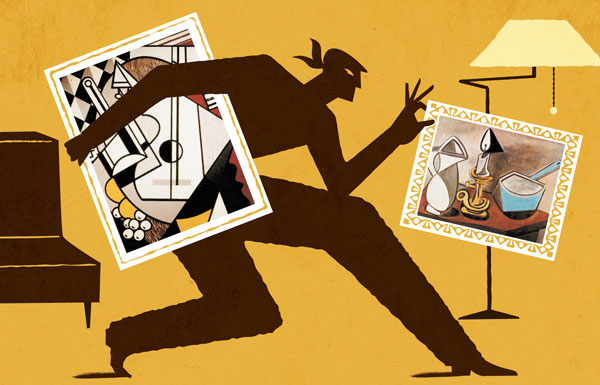
A manor house located in a quiet neighbourhood in the centre of Madrid has been the scene of the major contemporary art theft occurred in Spain in recent decades: five paintings worth in 30 million euros of the great Irish painter Francisco Bacon who died in Madrid in 1992.
The thief took place this last July and the police are investigating as quietly as possible the whereabouts of this collection. They are looking for the works in and out of Spain and although they still have not results, they believe that the paintings haven’t left the country.
This works were from J.B.C, a 59 years old friend of the painter and also, an art amateur who received them in heritage after his death.
The blow was very fast and quite. The authors of the theft take advantage of the absence for a few hours of the owner from the house located in a heavily guarded area a few meters from the Senate. Neither the keepers of the estate, of five heights, or the neighbours saw or heard anything. The thieves were able to disconnect the alarm and for this, the security centre didn’t receive any notice so they could walk through the house and take the five painting and other valuables objects. Moreover, the police suspected that while the robbery was taking place, other members of the band were watching the owner for tell if he returned home.
Police also guarded, without luck, Arco (the art fair that take place in Madrid and that suppose the home of dozens of galleries around the world that attracts buyers from different nationalities) hoping to know about some movement of the stolen paintings.
So the robbery was a work of professionals: they don’t let any fingertip or loose ends to help track them and also, for the planning.

In the heart of the sea

I would like to talk to one film that I have recently seen: In the heart of the sea. I really enjoy this film (not only for the main character, Chris Hemsworth) for the story itself. This film is based on the novel Moby Dick, written by Herman Melville (1819 – 1891) and published in 1851. This book is one of the top works of world literature and for write it, the author was inspired in a totally true story: a great albino animal of these characteristic has existed wandering the ocean, sinking boats and being chased by the most daring whalers. So the book tells the story of the whaler Pequod commanded by Capitan Ahab, who had the obsessive and we also can say, self-destructive, hot pursuit of a great white sperm whale.


I think that one of the things that I like most of the story itself is the fact that it really could be a real one. At the beginnings of the 19th century, whaling was probably the most dangerous, unpleasant, and less rewarded of all occupations. Signing for a trip whaling could mean beeing up to five years away from home and a trip to the end of the Earth. The life of a whaler was between blood and blubber, with long periods of boredom and often, with violent deaths, but it was a big business. The whale blubber provisioned to the streets of London, New York, Berlin or París the necessary fuel for to illuminate them and most machines of the industrial revolution used the same fuel.
For this, it’s strange how rarely Moby Dick has been filmed, this story has never been a Hollywood obsession as other popular and good know adventure books as Twenty Thousand Leagues Under the Sea or Journey to the center of the Earth, both of Julio Verne, that had been on screen several times. Anyway, this adaptation is a very good one if you didn’t know about Movie Dick story or if you want to know more about it.
The film, directed by Ron Howard, although tell us the same story, it’s narrated in a different way. In 1850, the young Herman Melville (author of the original book),  visits Thomas Nickerson, the last survivor of the whaler Essex, and he’s willing to pay him for know the story of Movie Dick. This sailor put us in the winter of 1820, when the Essex, a British whaler, was assaulted by something that nobody could imagine: an enormous size albino whale with almost, the human sense of revenge, and it comes the second big difference with the book: the novel only tell us the mind of the story, In the heart of the sea reveals us the terrible consequences of the meeting, when the survivals of the crew, among them who narrates the story, were forced to their limits and were compelled to make the impossible to stay alive. They had to face storms, the famine, the desperation and the panic. In that context, all men doubt even about their belief, about the value of their lives and also, about the morality of their office.

dissabte, 12 de març del 2016

Can technology make a better world?

At this stage, we can’t deny that technology and also, science, has made life easier, simple and more enjoyable: it has made great contributions to human life. However, there still a lot to do for making a prosperous, sustainable and equitable world in the future. So we also have to consider if we are going in the right direction or if technology is injuring us. I think that we, as humans, should be able to control, lead or bring science and technology and not the other way. If we look through the years, we can see that technology has rapidly developed and had had a great impact on human life. Nowadays, everything in our life deals with science and technology, but we have to ask if our society has changed thanks or because technology development. 
We can think that technology hasn’t made the world an easier or a better place to live. It’s true that day to day, tasks and everything we do have become easier but it has been at the price of losing the ability to think for one's self and losing social interactions. People are getting used to don't think anything, we don’t remember information (or not make the effort of remembering it) because all of us know and expect that our phone, our computer, the Internet,…do it for use; everyone know that typing a question in Google means having an immediate answer… and more importantly: technology have had an important impact on human’s ability to interact with others. We are losing our manners, we’re impolite, we play with our IPad or phone when we’re supposed to be speaking with the person that we have in front of us (in that line, I recommend this video: https://www.youtube.com/watch?v=wgavjtcnC3o that talks about what happens around you while you’re looking your phone!). How many times have you seen a group of people in a restaurant looking their phones instead of looking each other? Or what's worse, how many times have you seen someone talking with a prson through the phone when they have ech other just in front?
I believe that technology should solve problems without creating new ones, and with this criterion, unfortunately, we could have an endless list of “technological advances” that didn’t lead to practical solution. For example, let’s take the use of the petroleum for make automobiles work. At the time, people thought that it was one of the best breakthroughs of the history of the mankind: your car could take you anywhere you wanted. But if we look closer, we would see that it emit huge amounts of carbon dioxide what contributes to the greenhouse effect, the global warming and increase the ozone depletion, what endangers the earth and the human life. 
For this, we should make science and technology a problem solver. Have you ever thought about how Alexander Graham Bell invented the telephone? Well, so Bell, at that time, was facing a problem: he wanted to talk to his family even though he was miles away from them so this problem forced Bell to think and search a solution and, with hard work, he solve his problem by inventing the telephone. The same happens with the electric lamp of Thomas Edison: if he hadn’t been persistent enough to try until his 100th light bulb, he wouldn’t invent it; scientists would never have discovered the nuclear power founding a new energy called nuclear energy if they had felt content with hydroelectricity; or if after invent the pencil it hasn’t been the necessity of erasing what you have drawn, the rubber would have never seen the light. 
So we can look upon that technology has to sides: maybe we can say that we have get to a point at which we shouldn't reached, we’re in the midst of a "reverse evolution" in partly, due to our technology addition. For this, both science and technology, should be a never ending work in progress, it doesn’t mean that we are not allowed to relax and enjoy our progress, but being satisfied with our improvements will not lead in not moving and step forward. In the other hand, we can’t deny the fact that technology has improved our world, we only have to take as an example the medicine that continues to improve day by day.  
Summing up, technology is neither good or bad, but it’s powerful. It’s up to the people who develop and use it to determinate what effect it has on the world and it’s in our hands to use this powerful tool in ways that improve the world: it’s simple, science and technology can improve life if you work to improve science and technology.

diumenge, 6 de març del 2016

New book on the shelves of the Germany high schools

If the educational authorities of the country and the German government accept the proposal of the Association of Teachers and Education Minister, a new critic edition of the Mein Kampf (1925) will become a compulsory lecture and will be studied in all German high schools.
This book has been the most polemic and dangerous book in Germany and whose reprint has been prevented for 70 years. But now, taking advantage that the rights of the book written by the head of the Holocaust due this year, a small government sector want to introduce the new edition commented in the educational system.
This book contains both autobiographical data and the nationalist, racist and violent ideology of the author. Introducing that book into the high schools, according to the authorities, should serve to immunize German youth against the extremism political. They also think that the thought of the dictator should have an answer of the  21st century Germany youth and in that way, instead of allow that the charm of the forbbiden captivates the young people (because they can find this book on Internet), is much better that the students know this text helped by their teachers: it’s a good idea talk about this topic.
The oppositions to this proposal hasn’t been slow to appear and in fact, there are several politic sectors and different associations that consider that the new edition could serve to help spread the Hitler thoughts.
I think that this proposal is a right one and it comes at the right time: in German schools, the holocaust and the collective responsibility were spoke before any other place and, after all, we’re talking about one of the books that have had most influence on the Germany population in the history of the country and from now one, it will be on the shelves of the high schools besides other works; that one will not be there for his quality but for the capacity and the power that it have had, I mean, for the capacity of mobilizing an entire country.
As well as, in that way, German students will not just know what Hitler said but they will know what and why. In fact, I think that it is impossible to achieve a knowledge without understand. We know what was the anti-Semitism of Hitler but we don’t understand why for Adolf Hitler was more important exterminate a race than win the war. Yes, of course, we have plenty of theories, hypothesis, causes and motivations but no one of this explains or justifies adequately what happened and for this, I think, this “catastrophe” still being incomprehensible for us.
Summing up, I think that the moment of talk about this topic in schools has come: the risk of the Mai Kampf it isn't to make readers into neo-Nazis, but it is that we remove the importance that it have had taking it as a book of the past that nothing has to do with us.

dissabte, 5 de març del 2016

The book thief

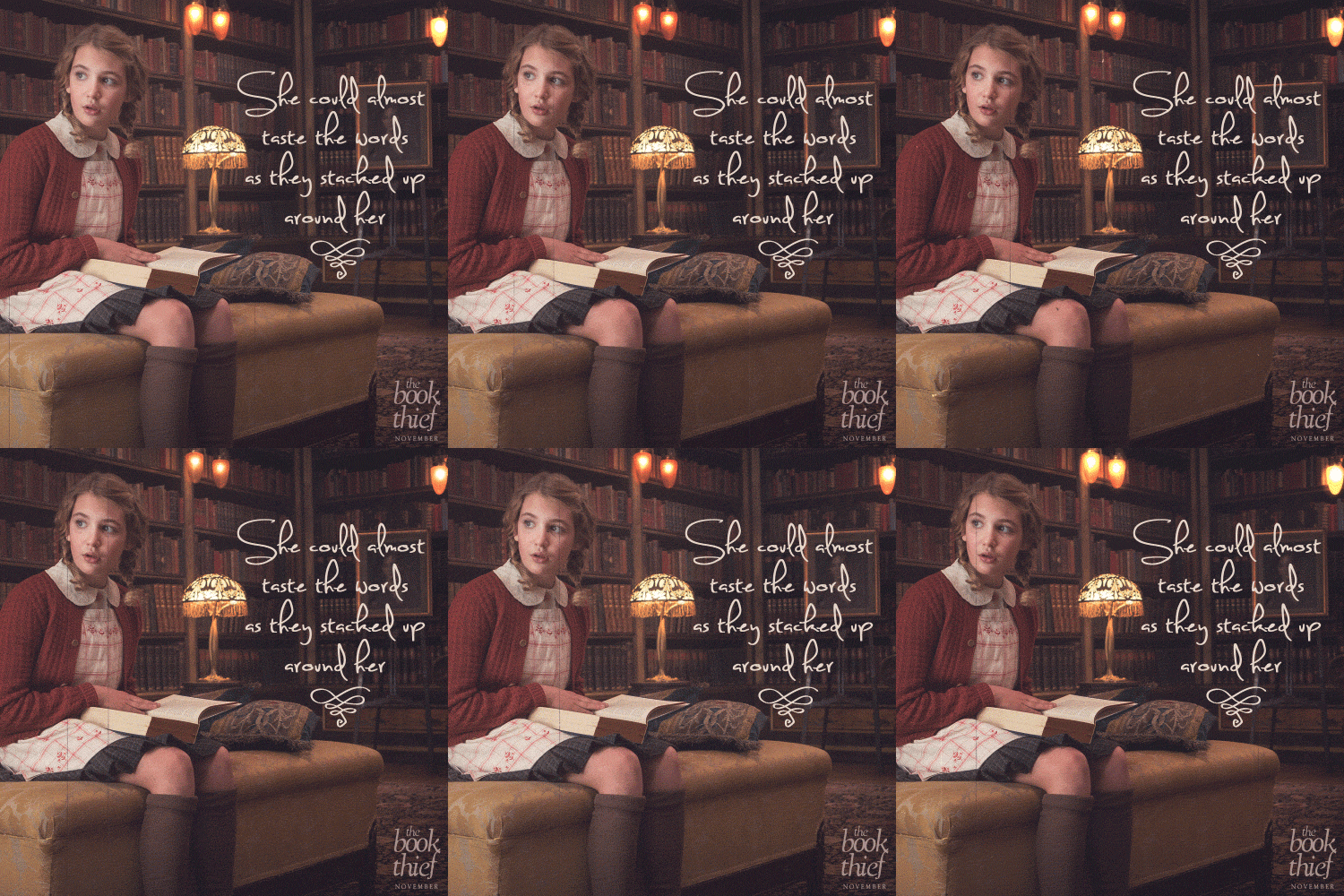
The Book Thief is a novel written by Markus Zusak, an Australian writer also known for other novels as Cartas Cruzadas. He published this book in 2005 and with it, he won the literary prize Michale L. Printz in 2007 and he achieved a record of 105 weeks on the list of youth novels of the New York Times. 
An interesting fact related to the biography of this author is the interest that he have, since he was little, about the Nazi Germany, the bombing of Munich, the Jewish abuse,… interests that linked with the different experiences lived by their parents, from Australia and Germany, during the Second World War helped and inspired him to write The Book Thief. 
Unlike other works as El niño del pijama de rayas of John Boyne, La bibliotecaria de Auschwitz of Antonio Iturbe or Bajo el mismo cielo of Núria Pradas and in which the authors talk about what was lived during the Second World War from different points of view: the son of a nazi general, Jews and prisoners in a concentration camp,… the The Book Thief does it from a quite different and less common perspective: from the point of view of German citizens who, as far as is possible, try to go on with their lives as the war is progressing. That way, the history of the novel revolves around the host family of Liessel Meissl, a little Germany girl who because of the war, she would live various adventures and misadventures, she would meet different characters that will mark her life as Rudy, a guy obsessed with Jesse Owen and who will became her best friend; Max, a young Jewish that Liessel family will try to hide in his basement and many others as Hans or Rosa, characters that will teach her the love of reading and writing. In fact, as the novel progresses, we will realize the reason of the tittle: Liessel, after get to her new home and after the death of his little brother, she develops a great love for the reading and writing thanks to her new father and her new friend Max and for this, she will try to gather and collect all books she found and even, she will steal some books from the library of the woman of the mayor of the city who will baptize she as “the book thief”.
Another singularity of this book that makes it special and different is the narrator: the death. She (not the typical one wearing a layer and holding a sickle) tells us, at the beginning of the novel, that there are few stories in the world worthwhile tell but that the book thief is one of those.
Personally, books with this kind of thematic, I mean, based on the First or Second World War, about the Nazi concentration camps and other historical facts are of my favourites whereby I have read a lot of them and I have to say that this one in particular, The Book Thief, surprise you for the originality of the narrator and for other things as the topics discusses or rather, the way that the author explains them because he doesn't focus, as the main majority, in the conflict itself or in the refugees or prisoners lives,  but history reveals us the life of the German population during the war: how young people were recruited, families without fathers, how the population reacts in the middle of the night in front of the sirens that announced possibleairstrikes and also, the more depressive and dark episodes of the war are mix with friendship or comic episodes and all narrated by an a compassionate death.
For all of this I think that, independently whether you like this genre or not, you should give a chance to this novel because it has a complete history inside, and if you don't feel like reading, last year was relased the film!!

"I fell in love online"

Meet someone in a bar or in a nightclub, flirting with a classmate, keep an eye on the most attractive guy/girl of the office, meet interesting people through friends and friends of friends,…there’s still people who resort to these “old tactics” to hook up, but we have to say that the new technology has put the hook up into a new level. In fact, according to a study done by Stanford University, California in which they asked more than 3.000 couples how they had met, Internet was the third resource most used for find a relationship. It was positioned behind the chances of “hook up in a bar” and “hook up through friends in common”.
The steady growth of the online world has opened different doors to personal relationships through different and new ways of communication: Messenger, Skype, social networks and even, through the video games! But we can’t forget the most important sites: the web pages specifically intended to find a partner (Meeting, eDarling,…). 
Find a relationship through internet is, relatively, a new option, but each time, are becoming more and more the singles who opt for this choices when it comes to dating. In sooth, according to a recent survey, it’s more than probable that you have already date someone who you met on Facebook or in any of this sites and if is not that way, I’m sure you know someone who has made it. Actually, there’s any difference between the “online” meeting and the traditional methods for find a parted, people who use this sites are searching for new friendships, casual encounters or an stable partner, the only difference is in the way to do it. Internet is another tool, neither better neither worst, it can go right or wrong, like in any other situation. In the same study mentioned at the begging, more than the half of the survey respondent, 59%, said that they were agree with the quote “Internet dating is a good way to meet people” in front the 21% who said that “online dating is for desperate people”. But, what happened to romance? Your eyes meet from across the room. He grabs your hand by mistake. You laugh, you talk and you marry two years later.
We all have our fantasies about that first magical meeting. I doubt any of us envisioned beginning our love story with “I logged on and liked his profile so I sent him a message’. Not romantic.  But if we really think about it, many events in our lives haven’t gone according to plan… and maybe for good reason.
There are stories with happy endings, but there also are cases in which at the other side of the computer, there was a person completely different from the one that the profile shows and not with the best intentions...What If he/she is a psychopath? Another concern is the chance of meeting someone crazy, socially inept or worst yet… married. It’s certainly valid.
The good online services have methods to minimize your contact with these types of people. Extensive questionnaires, private chats with usernames, and in-depth personality profiles are now common features of the services. Some of these test results are surprisingly insightful, the process of finding someone could actually help you find yourself. Go with sites recommended by friends who have used them. With the right service, meeting someone online is no more risky than meeting someone in a snack bar.
Anyway, a recent study have shown that it seems that Internet not only has changed the way people discover the love in life, but it also showed that couples that have met through chats, social networks and online platforms offers more guarantees of success in the relationship. This research was conducted through a survey of 20,000 Americans who married between 2005 and 2012 and of them, one out of three, had met her current partner online. Moreover, we also have to highlight that since 2005, the number of people who had had a meeting with someone that have met online grew from 43% this year to 77% in 2015.

At this point, we can say the phenomenon of dating 'on line' has become popular in a way that is not strange to meet someone who has met their partner on the internet. In fact, if we look at the most important sites as eDarling, for instance, we are surprised to see that there aren’t a “particular profile” but there is people of all shapes and colours: we can find young and not so young people, divorced and, why not, married people. In this particular site, eDarling, the 70% of the users are between 26 and 50 years-old, in FriednScout24, the 60% of the users is between 30 and 55 years-old, with 60% are men and the other 40 women.
So online dating has been around as long as the web made it possible for two people to communicate and now, millions of people search everyday profiles and photos of total strangers hoping to find that special someone. Ten years ago, told someone “we met online” was the equivalent of saying, “I’m desperate” but nowadays, it has completely change, either for better or worse.